
 Posted by
 Five long months of preparation, three intense warm-up matches, five weeks of pool action across four tough games, and then it’s all over in 80 minutes of quarter-final action. Sport is a cruel mistress.
Wales’ Rugby World Cup dream came to an end at the hands of Argentina in Marseille on Saturday, with the disappointment palpable amongst the players, staff and nation as a whole. An unlikely, especially 12 months ago, but ultimately achievable run to the semi-finals ended a week prematurely.
From a Welsh perspective it’s possibly a story of starting too quickly, perhaps even getting ahead of ourselves on the day, and failing to manage the momentum of the proceedings well enough against a quick and niggly Pumas side. Tie that in with another example of a Gatland side breaking down under the weight of physical strain at a World Cup, and it was a recipe for disaster.
For 30 minutes the men in red were largely dominant, benefitting from a well varied and well executed set of first phase strike plays that got us on the front foot and allowed us to put Argentina under pressure. It led to one of the team’s tries of the year, finished off by Dan Biggar, who converted it, added a penalty and could have scored three more points inside the first half-hour.
However, this is where Wales may have been lulled into a false sense of security against a slow starting Pumas as playing more rugby than we have in the middle of the pitch so far in this tournament produced positive results. Confidence was growing and there was a belief we could cause the opposition defence problems with ball-in-hand.
As analyst Sam Larner noted on Twitter, “(In the first half) Wales’ possessions on average finished 35m from the Argentinian line and gained 33m. In the second half they finished 39m from the Arg (sic) line and gained just 22m.” When momentum started to swing in the opposite direction, this ended up inviting pressure on to ourselves.
In the 10 minutes before the break the Pumas started to get a foot in the door. An aerial dominance, which saw them recover three of their own kicks while the Welsh were only able to recover one of our own, was compounded by a disintegrating lineout from the point-of-view of Warren Gatland’s men who gave up possession, territory and six points on the scoreboard.
Unfortunately this is where the inability to arrest that momentum swing came in as half-time failed to produce an answer to the problems Argentina were posing. The aerial game continued to be a struggle, a change of hooker did not assist the lineout as time ticked on with Emiliano Boffelli’s boot putting his side into the lead, errors began creeping in.
Even Tomos Williams’ moment of magic that put Wales back in front was immediately overshadowed by handling errors that offered the Pumas the opportunity to get right back into the game, and at this point it was obvious that a Welsh side under Gatland at a Rugby World Cup was physically breaking down again.
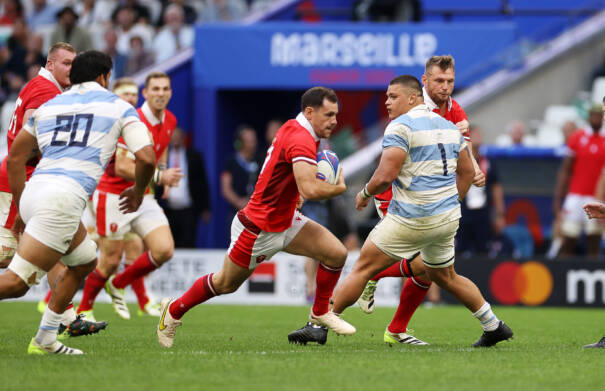
Liam Williams was noticeably struggling from the first two minutes with a knee problem, Dan Biggar was once more having to put his body on the line to drag the team forwards, Gareth Davies and Josh Adams both seemed well below 100% with the scrum-half in particular having been on a individual training plan to manage his workload for a few weeks.
Key men when it comes to the kicking game, aerial work and general game management, but they were simply physically unable to stop Argentina’s momentum in that second half, and so it came to pass that Michael Cheika’s men won the final 13 minutes by a 0-17 scoreline as Wales were almost powerless to stop them.
People may well point to some controversial refereeing or a try scoring opportunity than stemmed from a Rio Dyer line break, but ultimately the men in red were second best in too many aspects for too much of the game to win a Rugby World Cup quarter-final. One that was eminently winnable on paper, but wasn’t to be thanks to that early overconfidence mixed with the condition of the squad.
It’s a disappointing one on the day for certain, especially with some key players and incredible servants to Welsh Rugby likely saying goodbye to their international careers, and maybe their playing careers as a whole, after the final whistle.
Looking at the bigger picture though it’s still a remarkable turnaround for this team that was in turmoil last Autumn, had a change of coaching regime less than 12 months before a World Cup and largely limped through the Six Nations as Gatland desperately attempted to understand his squad and any combinations within that.
It’s been a whirlwind 10 months, and the players and staff can be immensely proud of what they’ve achieved to reach a quarter-final, getting within touching distance of another semi-final. Debate will rage about the way forward, with plenty of strong opinions on all sides, but that can wait for another day. For now it’s about reflection on a good job done.
I’m not a massive fan of Gatland by any stretch, but to take this group, lose a number of quality and experienced players from it, and still mould it into a Rugby World Cup pool winner is a major feat. You only have to look at the mess Eddie Jones has made of a similar job in Australia to understand the magnitude of his achievement.
Wales leave France with the likes of Corey Domachowski, Dewi Lake, Dillon Lewis, Dafydd Jenkins, Jac Morgan, Tommy Reffell, Aaron Wainwright, Taine Basham, Christ Tshiunza, Sam Costelow, Mason Grady and Louis Rees-Zammit having had a crucially important learning experience ahead of being in their prime in 2027.
Foundations have been laid, the Pivac era put to rest and pride restored in the jersey. It may not have been a total success on-the-field, but Wales can look back on France 2023 as a personal victory in a wider sense.
 Cardiff Rugby Life