 Posted by
 The Six Nations really is a competition like no other. From Paul Willemse’s double brain fade as Ireland romp to victory in Marseille for starters, to a mature looking Italy pushing England all the way in Rome for main course, and then the pièce de résistance as Wales almost complete the most remarkable comeback against Scotland in Cardiff.
Pre-tournament I was confident that Warren Gatland’s men would struggle – not from a negative point of view, but from a realistic standpoint. You don’t lose the experience and quality that the squad has done over the last 12 months and suddenly just produce a new generation of competitive international players. It doesn’t happen.
So when Scotland headed into the sheds at the Principality Stadium 0-20 up on Saturday evening, I wasn’t particularly surprised by the scoreline, just disappointed with how it had come about.
Wales had been sent out with completely the wrong attacking game plan for the players in the squad. Long gone are the days of Gatland and his staff beasting physical specimens like Alun Wyn Jones, Sam Warburton, Jamie Roberts and Alex Cuthbert until they become this well-oiled, direct and borderline bullying unit that can out-fight and out-work their Northern Hemisphere opposition.
This new crop, and the existing players left over from the last Rugby World Cup cycle, are less brutally effective and more skilfully effective. It’s evasion, rather than abrasion, as shown by the lack of big ball carriers in the back line in Cardiff on Saturday. So why on earth were the men in red trying to use their backs to pummel holes in the Scottish defence?
The likes of Corey Domachowski, Ryan Elias, Dafydd Jenkins, James Botham and Aaron Wainwright had hardly been given the opportunity to take the ball to the gain line throughout the first 40 minutes. The top ball carrier at half-time for the home side was Josh Adams as he roamed off the right wing and attempted to make hard yards through the middle of the field.
Attack came almost exclusively off the 10 jersey, with variations reduced to one inside ball that went nowhere, and as Wales went touchline-to-touchline without making any metres the opposition simply lined up, smashed us back and turned us over. There was no ground made, no pressure built and no scoring opportunities created. Tepid doesn’t even cover it, it was freezing cold offense.
That’s not to totally absolve the players of blame over what occurred during that first period though, the lack of intensity was a surprise given the occasion and the number of new faces. Line speed was non-existent, other than Gareth Davies’ classic spot blitzing, while the kick chase was unenthusiastic at best. If the toothless attack was the nail in the coffin, the missing vigour from the men in red was the hammer.
When Duhan van der Merwe scored in the first two minutes of the second half, Wales were dead and buried, or so it seemed.

Suddenly, the men in red’s attack was revitalised. The forwards began carrying the ball in earnest, speed of ball increased dramatically and Tomos Williams, introduced at half-time, was in his element. He threatened the fringes, fired passes across the faces of the Scotland defence, and got the ball to danger men in the space created by the forwards providing a platform from which we could play from.
Attacking sets went from four or five phases of no metres gained until being turned over, to 10 phases of varied attack, pushing and pulling the away side, earning field position and applying pressure until a penalty was conceded or an edge was found.
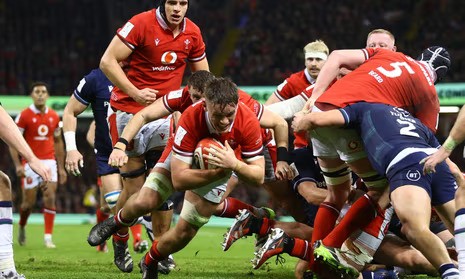
The fresh legs from Elliot Dee, Keiron Assiratti, Alex Mann and Mason Grady in particular raised the intensity, and in the blink of an eye the new approach had forced Scotland into a corner where they received two yellow cards for cynical and repeat offending, and Wales were over the line four times in 20 minutes.
In the end the mountain was simply too steep to climb and the men in red just slipped on the way to the summit, but the effort of the second half was summed up by a desperate defensive set on our own line in the dying seconds to retain two losing bonus points and prevent the visitors from scoring their fourth try.
I live in hope that Gatland and his coaching staff were privately woken up by that second half to the realisation that they got it totally wrong in the first half, and if the platform is provided then this squad can really play. The talent within this squad when given a yard of space to work in is borderline scary.
I’d also warn against singling out individuals as poor or game-changing, simply because the difference in approach from one half to the other was so different. Scrum-half is always a great example of this, where if the starter and replacement were switched then Tomos would have struggled and Davies would have taken the plaudits, as both would have been handcuffed in the first 40 and been able to shine in the second.
That goes for the Head Coach too who bizarrely decided to focus on Josh Adams conceding a penalty in the first half that, while admittedly unnecessary, was not “the difference between winning and losing the game”. If he doesn’t concede that penalty then the following 70 minutes or so look totally different. It’s such a nonsensical claim to make.
To end on a positive note though – Corey Domachowski. An 80-minute shift from the loosehead making his Six Nations debut and just a third start for Wales, who held his own against British & Irish Lion Zander Fagerson at scrum time, carried and tackled all over the field, and showed off some sharp handling at first receiver.
The first half is one to forget, but the second half is the blueprint for the men in red to build on. Ymlaen i Twickenham!
 Cardiff Rugby Life